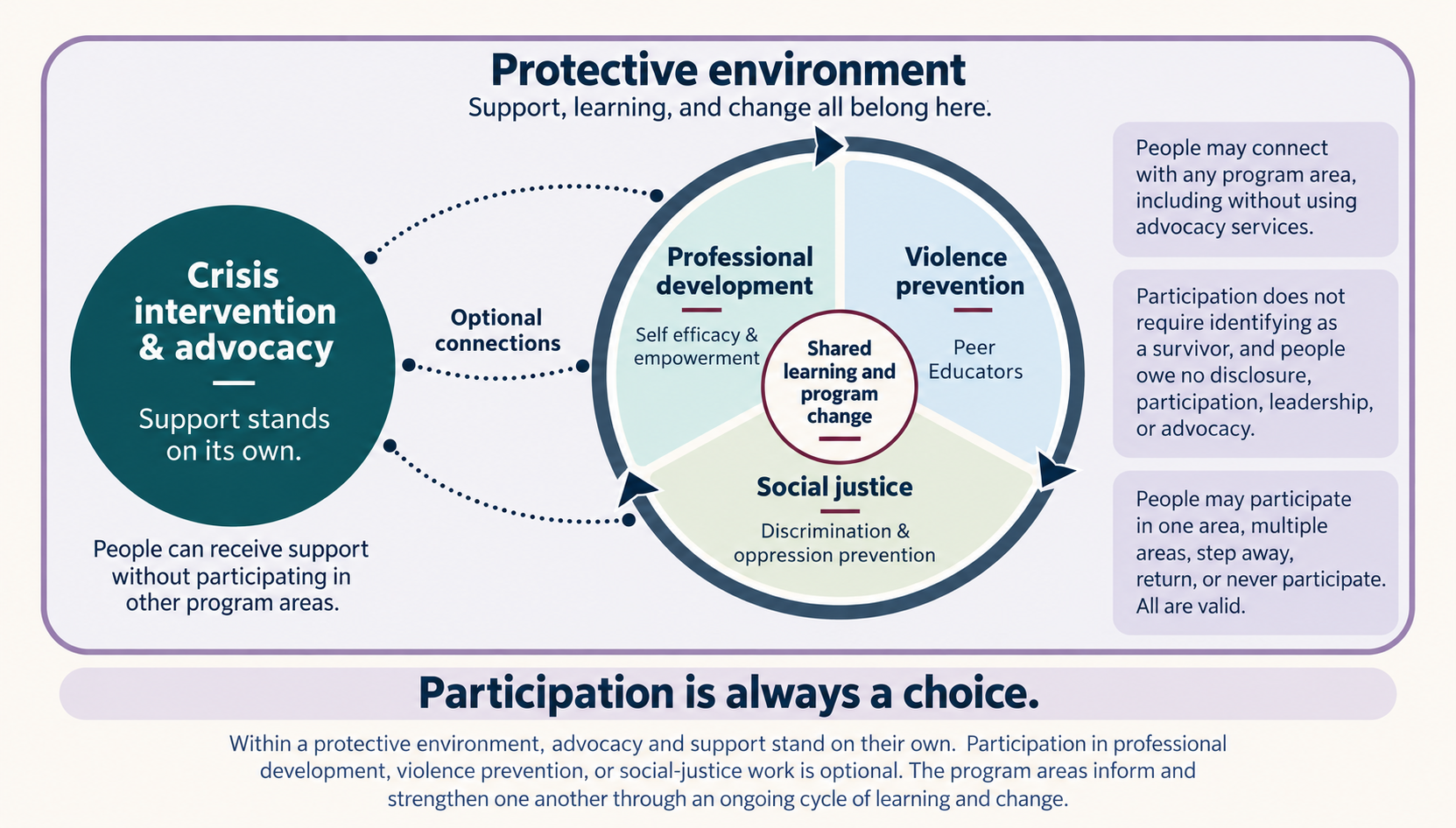
I design programs and working systems so that each part strengthens the others. Support can open a path to participation. Participation can build confidence and leadership. What people learn can shape the next round of decisions and change the system itself.
01
Programs that strengthen one another
Safe@Weber & Women’s Center · Weber State University
At Weber State University, I designed the Women’s Center’s work to connect advocacy, violence prevention, social justice, and professional development. These were parts of a shared structure: support for people’s immediate needs, opportunities to build agency, and collective work to change the conditions around them.
Protective environment
Crisis intervention & advocacy
Support stands on its own.
Professional development
Self-efficacy & empowerment
Violence prevention
Peer Educators
Social justice
Discrimination & oppression prevention
The program areas share learning in a continuing cycle. People choose whether, when, and where to connect.
Participation is always a choice.
The model is described in text below. Open the full-size image if you prefer to explore the artwork.
Within a protective environment, crisis intervention and advocacy stands independently as a complete and valuable service. Three other program areas reinforce one another through shared learning and program change: professional development, social justice, and violence prevention.
Dotted lines show optional connections between advocacy and the three program areas. Clockwise arrows show relationships between programs, not stages of healing or required participant journeys. People may connect through any program area, participate in multiple areas, step away, return, or never participate. No one is required to use advocacy services, identify as a survivor, disclose an experience, or take on leadership or advocacy responsibilities.
Participation is always a choice.
Students were participants in shaping this work. My model connected services with leadership opportunities, training, peer education, and paid roles. Through community participatory action research (CPAR), we learned and acted with the people most affected, using that learning to support student growth and improve our programs.
02
Make a complex institution easier to navigate
Respect for All app · OHSU
Start with the person’s situation
At Oregon Health & Science University (OHSU), my work on the Respect for All app included mapping how people could find support and reporting options across different roles and locations. The logic considered immediate safety, resource eligibility, and what the person wanted to do next.
Situation
Safety, role, and location
Options
Support, care, community resources, and reporting
Choice
What to explore and what to share
Simplified from a historical app-logic document; this is a design example, not a current service directory.
Confidential Advocacy Program · OHSU
Connect local access with shared coverage
I built a regional hotline system with community partners so a distributed institution could offer access to advocacy. Behind the phone lines was a coordinated structure: regional entry points, a shared staff setup, and forwarding to partner organizations. Working through those relationships and technical handoffs was part of making the service possible.
PortlandAshlandMonmouthKlamath FallsLa Grande
Regional entry points
Default path
Shared staff phone setup
When forwarding is enabled
Regional community partners
Redrawn from a historical call-flow sheet. Internal numbers, extensions, and staff identifiers are omitted.
03
Design information around the questions that matter
Intersectional Acts
In my Supportive Measures Database schema work, I connected information about support with the experience of seeking it: barriers, accessibility, outcomes, and feedback. A catalog can describe what is offered. A learning system also needs a way to ask what happened when someone tried to use it.
From available support to learning and improvement
Support
What an institution offers
Experience
What happens when someone seeks it
Barriers and access
What helps or gets in the way
Outcomes
What changed for the person
Feedback and reflection
What people and advocates learn
Next cycle
Use that learning to improve the work
A conceptual summary of historical draft schemas, not the full database structure or a claim about current data collection.
04
Turn the model into work people can carry
Development & Fundraising · Vámonos Outside
At Vámonos Outside, I built a development operating system in monday.com to connect relationship information, fundraising workflows, stewardship, and staff responsibilities. The design work included deciding where information belonged, who needed to act next, what required human review, and how people could recover when a workflow did not go as expected.
A connected development workflow
Capture
Bring information into the workflow
Review
Resolve questions before moving ahead
Coordinate
Connect the record, next action, and owner
Follow through
Track stewardship and the relationship over time
Human review runs through the system. When information is unclear, staff can hold the workflow for review before it moves forward.
Illustrative workflow based on my design and testing records. No client records or live board configuration are shown.
Testing was part of the build. I used controlled scenarios to compare expected and actual behavior, identify defects, and retest corrections. Documentation, manual fallbacks, and clear handoffs mattered alongside the automation.
05
Build in a way to learn—and change
Across these projects, I return to the same questions: Who is this for? What do they need? How do the parts connect? Who can make a decision? What will tell us to change course? My process makes room for the people doing the work to help answer those questions.
Listen and define the vision
Plan with the people involved
Take action
Observe, analyze, and reflect
Share findings and revise
Then begin again, with what we have learned. This is a synthesis of the iterative process shown in my primary-prevention presentation.
For nonprofits and mission-driven teams
Let’s make the connections work.
If your team needs connected programs, clearer workflows, or a custom monday.com system, I’d love to hear what you are trying to make possible. We can start with the work you need to do and the capacity you have.