Selected work · Weber State University · Safe@Weber
Building LGBTQ+ student leadership through research and consent education
The curriculum was one outcome. The process also created paid opportunities for students to ask questions, interpret evidence, and shape an educational response.
Standard reading mode is shown. Without JavaScript, both versions are available.
As director of Weber State's Women's Center and principal investigator for this project, I designed a participatory research process that connected LGBTQ+ students' learning and leadership with the development of consent education. Students helped shape the questions, interpret what we learned, create educational materials, and share the work with other practitioners. My responsibility was to build the funding, preparation, relationships, and structure that made that participation possible.
How we built the work together
Create paid roles with real influence
I built the funding, preparation, and shared responsibilities that allowed LGBTQ+ students to help lead the research. Participation was part of the project’s design, with opportunities to ask questions and develop their own ideas.
Start with community experience
A survey and Photovoice brought people’s experiences of consent, relationships, and discrimination into the inquiry. Photographs opened conversations that a survey alone could not carry.
Make meaning together
Students and community members discussed what the material revealed. Shared interpretation helped connect individual experiences with patterns that could guide the educational response.
Turn what we learned into education
The team developed consent education, a facilitator guide, and supporting materials. Feedback helped us examine whether the work reflected the experiences and questions that had shaped it.
Reflect, revise, and share the work
The project grew to include the short film Valid, conference presentations, and a NASPA webinar. Sharing the materials and the participatory method extended the work beyond a single curriculum.
This was a repeating cycle of inquiry, action, and reflection, rather than a one-way sequence.
Make participation part of the design
Our team was responding to gaps in consent education for LGBTQ+ communities in Utah. Identity, social expectations, stigma, and access to support shaped the questions we needed to ask. I brought together public-health prevention approaches and critical, feminist, and queer theories to guide a process grounded in community knowledge.
Grant funding supported paid team roles, research training, and opportunities to practice leadership. We learned about prevention, research methods, community organizing, and peer education while doing the work. Students contributed to research, coding, curriculum and film scripts, and conference presentations.
The process was designed to strengthen participants' confidence, relationships, and ability to act in their communities. Our planning tools also made power part of the discussion: Who defines the problem? Who decides what happens next? Whose knowledge shapes the interpretation? What support does someone need to take part?
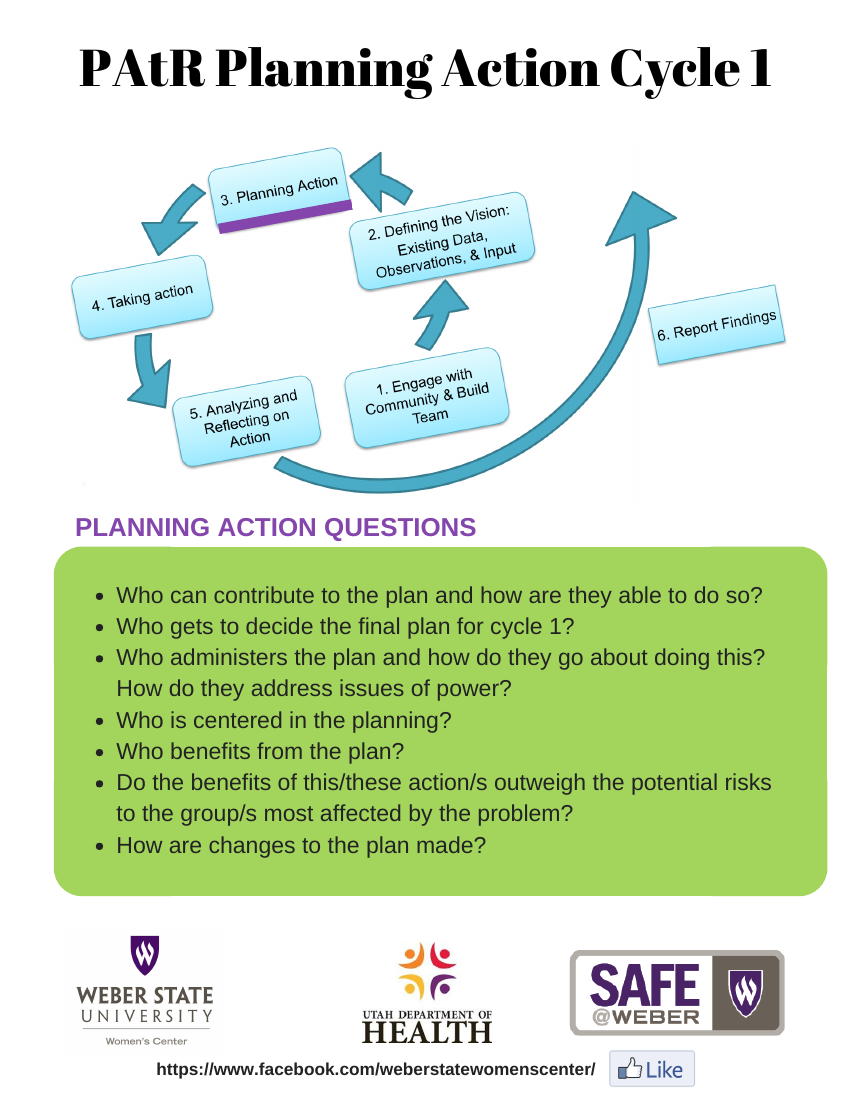
Make participation and power part of planning. A blank worksheet from the project’s participatory action research toolkit; this is a planning resource, not a completed participant record.Read the worksheet questions
Who can contribute to the plan and how are they able to do so?
Who gets to decide the final plan for cycle 1?
Who administers the plan and how do they go about doing this?
How do they address issues of power?
Who is centered in the planning?
Who benefits from the plan?
Do the benefits of this/these action/s outweigh the potential risks to the group/s most affected by the problem?
How are changes to the plan made?
The worksheet also shows a repeating research cycle: engage with the community and build a team; define the vision using existing data, observations, and input; plan action; take action; analyze and reflect on the action; report findings.
Source: PAtR Planning Documents, page 7.
Let each stage inform the next
A community needs-assessment survey informed our next questions. We then used Photovoice, a method in which people explore questions through photographs and discussion. Participants helped expand the framing questions, made images and reflections, and returned to interpret them together.
The team considered both individual accounts and the meanings developed through group discussion. We left room for themes we had not anticipated. Questions about isolation, social expectations, communication, and barriers to consent became material for curriculum learning objectives and activities.
This created a direct connection between inquiry and education. The curriculum addressed communication, boundaries, consent, victim blaming, supporting survivors, and finding resources, using material shaped by the community's own questions.
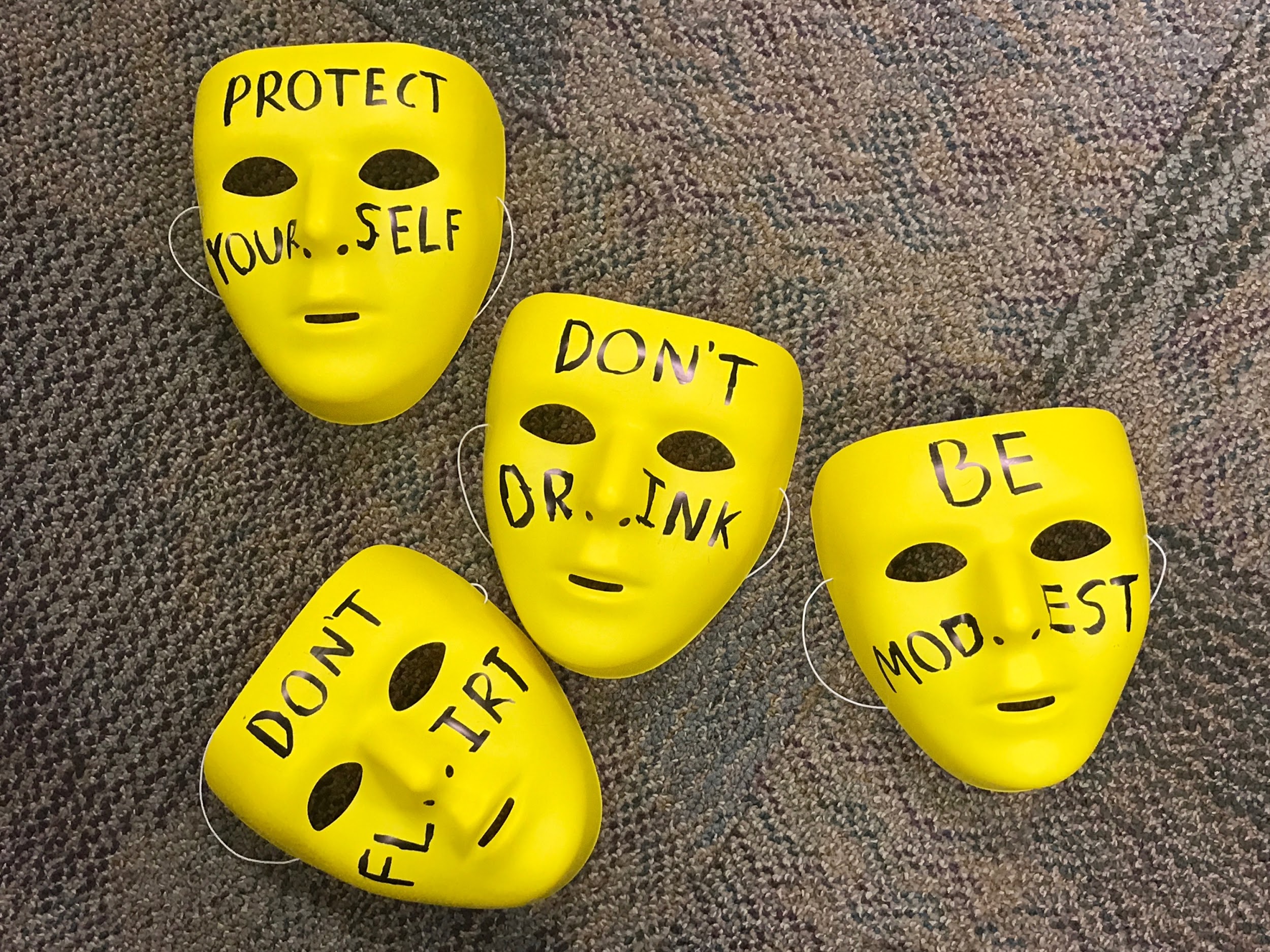
An example used to introduce Photovoice. A paid student team member created this illustrative resource to help participants discuss what they might explore through photographs. It is not presented here as a participant research finding. Reproduced with permission; the creator is unnamed at their request.Working themes from early exploration. A condensed reading of an early student-generated theme exploration, revisited for this portfolio. These groups are not ranked and are not the project’s final coding framework.Read the grouped themes
Support and belonging
Resources and education; Connection within community; Feeling able to take part.
Communication and connection
Speaking openly about sex; Verbal and nonverbal cues; Healthy relationships.
Consent and boundaries
Ongoing, revocable consent; Comfort and personal boundaries; Benefits of shared understanding.
Identity and self-exploration
Understanding oneself; Guilt, judgment and shame; Putting oneself out there.
Social norms and stigma
Expectations and assumptions; Myths about consent; Exclusion and stigma.
Power, harm and accountability
Coercion and victim blaming; Risk and harmful relationships; Responsibility for harm.
Adapted from the project’s early theme cloud. Overlapping labels have been combined; the original is preserved in the project records.
Let feedback change the work
We brought a draft curriculum back to community members through a workshop, pre/post assessment, and a focus group. Their feedback identified a gap: the existing victim-blaming video did not reflect LGBTQ+ experiences closely enough.
The team responded by developing the short film Valid. Students contributed to its script, and the facilitator guide paired the film with questions and discussion about responsibility, support, and responses to harm. Community feedback changed an educational tool people would actually encounter in the workshop.
The resulting materials included a workshop, facilitator guide, practice activities, handouts, and the film. The work moved through repeated cycles of inquiry, action, review, and revision.
Pay attention to student learning
The project included reflection and self-assessment of relationships, communication, boundary setting, leadership, and cultural understanding. In internal reflections, team members described learning to work together, communicate more openly, and apply prevention skills in their own lives.
These accounts help explain how students experienced the project. They are small-team self-reports, rather than a causal evaluation of long-term outcomes. They also show why the process of developing the curriculum belongs in the story alongside the finished materials.
What the paired self-ratings show
Five team members had paired initial and Spring 2017 self-ratings. The table reports the average change in each person’s self-rating on a 1–5 scale.
Mean point change across five team members
Area
Point change
Trusting relationships
+1.4
Self-assertion
+1.7
Healthy communication
+2.2
Social relationship
+1.8
Boundary setting
+1.4
Initial assessments were taken as team members joined in fall or winter; follow-up ratings were recorded in Spring 2017. Five people had paired ratings. A later team member had no paired ratings and is excluded. These small-team self-reports do not establish that the project caused lasting change.
Mean point change across the rubric items, five team members
Area
Point change
Leadership and management
+1.18
Cultural understanding
+0.93
These rubrics used a stated 1–4 scale. Two leadership ratings were recorded as 4.5 and are retained in the calculation. Each result averages the changes across the rubric’s items and five team members.
Share a method others can use
We shared the project and its participatory approach through conference presentations and a NASPA webinar. The Safe@Weber LGBTQ+ project received NASPA's 2018 Best Practice in Prevention Activities award.
Our participatory research toolkit gave other practitioners prompts for building a team, examining power, planning action, and reflecting with the community. It translated the approach into questions colleagues could use in their own settings.
This work connects community knowledge with program design, education, and institutional decisions.
Project materials and public context
This account draws on project presentations and scripts, the facilitator guide, participatory research planning tools, and internal team self-assessments. Students and community collaborators contributed to the research and educational materials. Selected visual materials are reproduced with permission.
At Weber State, I directed the Women's Center and led this research project. LGBTQ+ students helped choose questions, understand the findings, and create education about consent and relationships. They also helped present the work to other practitioners. I organized the funding, training, and support that helped the team do this work.
How we worked together
Pay students and prepare them to lead
I created paid roles and training for LGBTQ+ students. They helped decide what to study and had real responsibility for the work.
Listen to people’s experiences
We used a survey and Photovoice. In Photovoice, people use photographs and discussion to explore their experiences. This helped us ask about consent, relationships, and discrimination.
Discuss what we learned
Students and community members looked for patterns together. Their discussions helped us decide what the teaching materials needed to address.
Make teaching materials and ask for feedback
We made consent lessons, a guide for people leading the lessons, and other materials. We used feedback to improve the work.
Keep improving and share the work
We also made the short film Valid and shared the project through conference presentations and a webinar. We shared how we did the research as well as what we created.
We returned to these steps as we learned. We did not simply finish one step and leave it behind.
Prepare people to lead
We wanted consent education to reflect LGBTQ+ experiences in Utah. We used ideas from public health and theories about power, gender, and sexuality to guide our questions. Community knowledge helped us understand what needed to change.
Grant funding paid team members for their work. We learned research methods, ways to prevent violence, community organizing, and peer education together. Students helped study the findings, write curriculum and film scripts, and give presentations.
We also wanted students to build confidence, relationships, and skills they could use in their own lives. Our planning tools asked who could take part, who made decisions, whose ideas were heard, and what support people needed.
Make participation and power part of planning. A blank worksheet from the project’s participatory action research toolkit; this is a planning resource, not a completed participant record.Read the worksheet questions
Who can contribute to the plan and how are they able to do so?
Who gets to decide the final plan for cycle 1?
Who administers the plan and how do they go about doing this?
How do they address issues of power?
Who is centered in the planning?
Who benefits from the plan?
Do the benefits of this/these action/s outweigh the potential risks to the group/s most affected by the problem?
How are changes to the plan made?
The worksheet also shows a repeating research cycle: engage with the community and build a team; define the vision using existing data, observations, and input; plan action; take action; analyze and reflect on the action; report findings.
Source: PAtR Planning Documents, page 7.
Learn with the community
We began with a community survey. Then we used Photovoice: people explored questions through photographs, written reflections, and discussion. Participants helped add questions and explain what their images meant.
We looked at what people said individually and what they learned together. We stayed open to ideas we had not expected. Their questions about isolation, social expectations, communication, and consent helped us decide what the curriculum should teach.
The education included consent, boundaries, communication, victim blaming, supporting survivors, and finding help.
An example used to introduce Photovoice. A paid student team member created this illustrative resource to help participants discuss what they might explore through photographs. It is not presented here as a participant research finding. Reproduced with permission; the creator is unnamed at their request.Working themes from early exploration. A condensed reading of an early student-generated theme exploration, revisited for this portfolio. These groups are not ranked and are not the project’s final coding framework.Read the grouped themes
Support and belonging
Resources and education; Connection within community; Feeling able to take part.
Communication and connection
Speaking openly about sex; Verbal and nonverbal cues; Healthy relationships.
Consent and boundaries
Ongoing, revocable consent; Comfort and personal boundaries; Benefits of shared understanding.
Identity and self-exploration
Understanding oneself; Guilt, judgment and shame; Putting oneself out there.
Social norms and stigma
Expectations and assumptions; Myths about consent; Exclusion and stigma.
Power, harm and accountability
Coercion and victim blaming; Risk and harmful relationships; Responsibility for harm.
Adapted from the project’s early theme cloud. Overlapping labels have been combined; the original is preserved in the project records.
Use feedback to make changes
We tried the curriculum with community members and asked for feedback. Participants completed assessments before and after the workshop and joined a discussion. Their feedback showed that a video about victim blaming did not reflect LGBTQ+ experiences well enough.
Our team developed the short film Valid in response. Students helped write it. The facilitator guide included questions to help people discuss responsibility and how to support someone after harm. We also developed workshop activities and handouts. We kept learning, testing, and revising.
Learn about the student experience
Team members reflected on their relationships, communication, boundaries, leadership, and understanding of other people. Some described learning to work together, speak more openly, and use prevention skills in their own lives.
These are participants' reports about their experiences. They do not prove that the project caused lasting changes for everyone. They help explain what students took from the work itself.
What the paired self-ratings show
Five team members had a rating at the start and another in Spring 2017. On average, their later ratings were higher in these five areas. These are changes in points on a 1–5 scale, not percentages.
Mean point change across five team members
Area
Point change
Trusting relationships
+1.4
Self-assertion
+1.7
Healthy communication
+2.2
Social relationship
+1.8
Boundary setting
+1.4
Initial assessments were taken as team members joined in fall or winter; follow-up ratings were recorded in Spring 2017. Five people had paired ratings. A later team member had no paired ratings and is excluded. These small-team self-reports do not establish that the project caused lasting change.
Mean point change across the rubric items, five team members
Area
Point change
Leadership and management
+1.18
Cultural understanding
+0.93
These rubrics used a stated 1–4 scale. Two leadership ratings were recorded as 4.5 and are retained in the calculation. Each result averages the changes across the rubric’s items and five team members.
Share the work
We shared the project at conferences and in a NASPA webinar. It received NASPA's 2018 Best Practice in Prevention Activities award. We also shared planning tools so other practitioners could build teams, discuss power, plan action, and learn with their communities.
This work connects community knowledge with program design, education, and institutional decisions.
Project materials and public context
This story uses the project’s presentations, scripts, teaching guide, planning tools, and team self-ratings. Students and community partners helped create the research and learning materials. The selected images are used with permission.